

Last updated: 15 Apr 2026 02:00 Posted in: AIA
Welcome to an interview with Tracey Wilson, Chief Examiner of the Association of International Accountants.
With more than two decades of experience across professional education and academia, Tracey Wilson has played a pivotal role in shaping how future accountants understand financial reporting, accountability, sustainability and ethical decision-making. As AIA’s Chief Examiner, she oversees the quality and integrity of assessments that support aspiring accountants worldwide.
Her career has focused on helping students to build not only technical expertise, but also the judgement and confidence required in a modern, globally connected profession. Her work reflects AIA’s commitment to high-quality education, international standards and public trust.
In this interview, Tracey shares her journey, her approach to assessment design, and why global frameworks such as the International Education Standards (IESs) and Statements of Membership Obligations (SMOs) are central to building a globally trusted profession.
You’ve been involved in professional education for over 20 years. What first drew you to teaching and assessment in accountancy?
My journey began at BPP Professional Education, where I quickly realised that teaching was the career I wanted to pursue and that I could support students in working towards their ambitions.
From the outset, I found it hugely rewarding to support students through what is often a demanding journey. Many are balancing work, family and study, and seeing their progression over time, particularly in their confidence and the way they think, is incredibly satisfying.
Accountancy carries real responsibility. Being able to help students prepare for that, and shape how they approach their role, has always been a strong motivation for me. Education is the gateway to a more ethical and competent profession, and that’s what keeps me committed to this field. Education is at its best when it builds confidence as well as competence.
You have taught corporate reporting, taxation, sustainability and strategic accountability. How have those subjects shaped your philosophy as an examiner?
Subjects such as corporate reporting, taxation and sustainability all require interpretation and an understanding of impact. They are not simply about applying rules. We need to develop critical thinking, professional judgement and the confidence to contribute to a profession that is evolving rapidly. Increasingly, accountants are expected not only to report on performance, but to help organisations navigate complexity and lead transformational change.
This is particularly important in a technology-enabled environment. Tools such as AI are creating new opportunities, but they also reinforce the importance of professional judgement. Outputs need to be understood, challenged where appropriate and applied with care.
As an examiner, that means ensuring that our assessments don’t just test whether candidates can memorise technical content. They must also demonstrate professional values, ethical reasoning and an ability to apply concepts in real-world scenarios. This aligns closely with the International Education Standards, particularly IES 2, 3 and 4, which emphasise technical competence, professional skills and ethics.
My role is to ensure that our assessments reflect this reality, combining technical rigour with the skills required in practice. The profession needs accountants who think critically, not just calculate accurately. And our exams should and do reflect that.
AIA continues to strengthen its alignment with global expectations for professional education. How does that influence your work from day to day?
In practice, it means being thoughtful about quality, relevance and consistency. AIA has always taken these seriously, but as we grow and deepen our international relationships, expectations continue to rise.
For me, it’s about ensuring that our exams remain internationally credible and comparable. We draw on global education frameworks and good practice when designing and reviewing assessments, while keeping the qualification relevant, fair and globally recognised without overwhelming students with jargon.
At its heart, it’s simply about preparing people for a profession that is increasingly international.
You’ve long championed critical thinking in the classroom. How do you help students develop that skill through assessment?
My ambition is simple: to help AIA produce accountants that the world can trust. By making them think, rather than recite.
We design scenarios that require interpretation, judgement and opinion, not simply plugging numbers into a formula. I want candidates to show that they understand why something matters, not just how to do it.
Critical thinking is also closely linked to ethics. If a student can spot inconsistencies, challenge assumptions or recognise when something doesn’t feel right, they’re already demonstrating the essential qualities of a professional accountant.
Sustainability appears in much of your teaching and thinking, including your certificate in Business Sustainability Management from Cambridge University. How do you see sustainability influencing the future of accountancy education?
Sustainability is no longer an optional extra but is becoming central to how organisations operate. Accountants are increasingly involved in measuring, reporting and advising on environmental and social impact alongside financial performance. That requires a broader skill set and a more integrated perspective.
For education, that means embedding sustainability across areas such as reporting, auditing, risk management and governance. It also means helping students to think beyond technical compliance. Future accountants will need to interpret non-financial data, advise on sustainable strategy, and engage with stakeholders who expect transparency. Students really value this approach, as it gives technical subjects real-world relevance and helps them see the profession’s influence on society.
You’ve had a tremendous impact on students throughout your career. How does that commitment to student support influence your work as Chief Examiner?
Supporting students has always been at the heart of what I do. Whether in the classroom or through assessment, I’ve always believed that education is most powerful when people feel seen, encouraged and guided. Many students arrive with doubts about their abilities and helping them grow in confidence is incredibly rewarding.
As AIA Chief Examiner, I try to bring that mindset into every part of the assessment process. Our exams should stretch candidates, but they should also feel fair, purposeful and rooted in helping them progress. I want students to come away feeling that the qualification supports their development, not just tests it. If we can foster resilience, self-belief and a sense of achievement, then we are doing more than assessing. We are helping to shape future professionals.
The AIA qualification attracts students from all over the world. How do you ensure fairness and consistency across such a diverse membership?
You start by acknowledging that your students come with a wide range of experiences and perspectives. Then you design assessments that are internationally accessible, culturally neutral and grounded in principles rather than local quirks.
We also review exam performance thoroughly to pick up any patterns that might suggest unintended barriers. It’s important that every candidate, wherever they’re based and whatever their background, has the same opportunity to demonstrate their competence. Consistency is a moving target, but it’s a non-negotiable one.
Looking ahead, what changes do you expect to see in the profession over the next few years, and how might exams evolve in response?
Three themes stand out for me. Technology-enabled judgment will become increasingly important as AI and automation reshape accounting tasks. Exams will increasingly need to test candidates’ ability to interpret outputs, exercise judgment and challenge results.
Ethical resilience will also be critical. With more data and automation comes greater ethical complexity. Professional scepticism, integrity and accountability will be tested in new ways.
Finally, integrated thinking will be essential. The lines between financial and non-financial information will continue to blur. Accountants will need to see the organisation as a whole system, including financial, environmental and social. Assessments will need to reflect this reality, with greater emphasis on analysis, judgement and context.
What impact do you hope to make during your time as AIA’s Chief Examiner?
I’d like students to feel proud of the qualification they earn and to know it genuinely prepares them for a meaningful career. I want our exams to reflect the best of the profession: integrity, fairness and curiosity.
And I’d like to keep pushing assessment forward in a way that feels supportive rather than daunting. If students finish their journey feeling capable, confident and part of an international community, then I think we’ve done our job well.
Finally, what advice would you give to AIA students working toward membership?
Believe in your potential. Every accountant was once where you are now. Stay curious, ask questions, and don’t be afraid to get things wrong. Mistakes are a feature of learning, not a flaw in you.
Finally, try to find some enjoyment in the process. It is a demanding journey, but taking the time to recognise your progress along the way really matters.
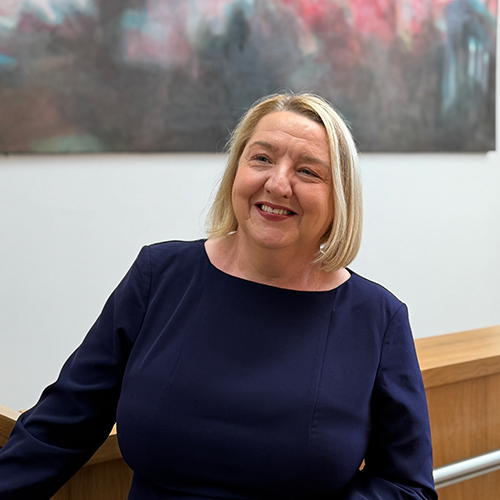
"My ambition is simple: to help AIA produce accountants that the world can trust."
Tracey Wilson, Chief Examiner, AIA